In the vast blue expanse of the Mediterranean, Sicily stands like a floating archive of civilizations. For thousands of years, the island lay at the heart of the Mediterranean trade network, acting as a stepping-stone between Europe and Africa, a crossroads between East and West, and a natural bridge linking the Latin and Greek worlds. Even medieval world maps depicted Sicily as “an apple at the center of the Mediterranean”—a sign of its strategic value as a fortified outpost, an information hub, and a maritime gateway.
Johann Wolfgang von Goethe famously wrote, “To have seen Italy without having seen Sicily is not to have seen Italy at all.” His admiration was more than poetic sentiment; it pointed to Sicily’s unique cultural density—its extraordinary synthesis of layers and epochs. The island holds six of Italy’s twenty-four World Heritage Sites, and the ever-present sculptures of spiral-legged figures lend an air of mystery to its urban landscapes. Here, cuisine—like architecture—is a living palimpsest of the peoples who conquered or settled the island: Greeks, Romans, Arabs, Normans, Aragonese Spaniards, and others.
If the Italian peninsula’s gastronomy resembles a long-running series shaped by local terroirs, Sicilian cuisine is a three-thousand-year epic co-directed by multiple civilizations. Its flavors are not merely regional; they are historical documents.
1. The Greek Foundation: Establishing the Mediterranean Culinary Grammar (8th Century BCE onward)
Greek colonists were the first to lay down a coherent culinary framework in Sicily. As part of Magna Graecia—the “Greater Greece”—Sicily absorbed the key pillars of ancient Mediterranean gastronomy:
- Olives and olive oil, which became indispensable cooking fats
- Grapes and winemaking, embedding viticulture deeply in rural life
- Wheat and bread culture, helping Sicily later earn its Roman title as the empire’s “granary”
- A dietary structure centered on fish, legumes, vegetables, and cheeses
Many culinary practices still visible today trace back to this Hellenic phase. Coastal preparations of poached or grilled fish, the use of lemon as a natural brightener, and combinations of cheese, herbs, and honey in sweets all echo ancient Greek techniques. Even certain dips—such as eggplant or fish-based spreads—carry faint memories of classical recipes.
The Greeks gave Sicily a sea-oriented culinary logic, emphasizing freshness, simplicity, and the essential flavor of ingredients. This foundation would become crucial for the island’s later layering of Arab and Norman influences.
2. The Arab Revolution: Transforming the Soul of Sicilian Flavor (9th–11th Centuries)
If the Greeks established the island’s culinary grammar, the Arabs rewrote the flavor profile entirely. Their two-century rule marked the most transformative period in Sicilian food history.
(1) A Revolution of Ingredients
Many ingredients now considered quintessentially Sicilian arrived with Arab settlers:
- Eggplant (the heart of countless Sicilian dishes)
- Citrus fruits—lemons, bitter oranges, sweet oranges
- Almonds and pistachios
- Apricots, sugar cane, rice, and saffron
Without Arab agricultural innovation, Sicilian cuisine as we know it would not exist. Eggplant alone would later become the cornerstone of iconic dishes such as caponata.
(2) A Revolution of Techniques
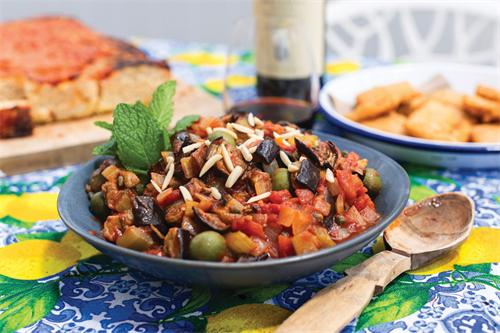
Caponata
Arab influence ushered in sophisticated food technologies:
- The use of Mount Etna’s snow to make early forms of sorbet and granita
- Sugar refining techniques, enabling elaborate pastries and confections
- Methods for producing dried pasta, a precursor to Italy’s pasta culture
Most importantly, the Arabs introduced a new culinary aesthetic built around the harmony of sweet and savory. This sensibility is still deeply embedded in Sicilian everyday cooking.
Caponata, for example—eggplant stewed with onions, tomatoes, and a sweet-and-sour glaze—is a direct heir to the Arab taste for layered, contrasting flavors.
(3) Cultural Continuity Across the Sea: Sicilian Couscous
Nowhere is Arab influence more visible than in Trapani-style fish couscous. Couscous, originally a North African staple, was adopted and transformed by Sicilian fishermen, who used rich broths made from local sea fish. What began as a Maghrebi grain dish evolved into a symbol of Western Sicily’s maritime identity.
The Arab period gave Sicily color, fragrance, and depth. It transformed a simple Mediterranean island kitchen into a vibrant crossroads of spices, sweetness, and agricultural abundance.
3. The Normans: Integrators and Refiners of a Multicultural Table (11th–12th Centuries)
The Normans—northern conquerors often stereotyped as culturally unsophisticated—brought something Sicily desperately needed after centuries of fragmentation: a unifying structure.
Though they introduced relatively few new ingredients, the Normans played the role of:
- Integrators, bringing Arab, Greek, and Latin elements into one political and cultural system
- Refiners, elevating rustic and street-food traditions into courtly cuisine
- Organizers, establishing formal banquet structures and expanding the use of game and poultry
Their architectural legacy mirrors this culinary synthesis. The Norman Palace in Palermo, for instance, seamlessly merges Arab arches, Byzantine mosaics, and Norman engineering. Sicily’s cuisine underwent an analogous fusion: ingredients of one culture, techniques of another, and presentation influenced by a third.
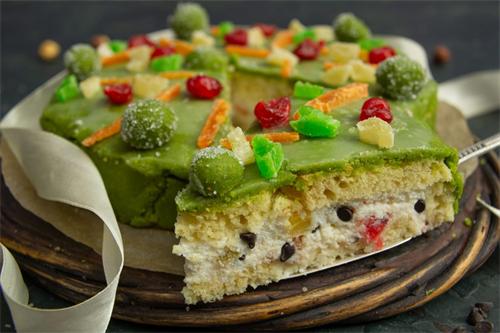
Cassata cake
The famed cassata cake—sweet ricotta filling (Arab sugar and dairy techniques), almond paste, and jewel-like candied fruits—was perfected in monastic kitchens during Norman times. It emerged as an emblem of feast days, symbolizing abundance and celebration.
4. Spanish Influence and the Arrival of New World Ingredients (15th–17th Centuries)
Under Aragonese Spanish rule, Sicily absorbed ingredients brought from the Americas such as:
- Tomatoes
- Chili peppers
- Chocolate
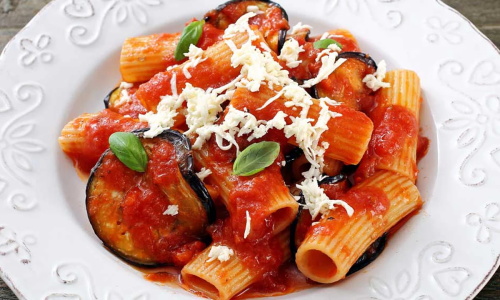
Pasta alla Norma
Tomatoes, in particular, revolutionized local dishes and enabled the birth of modern Sicilian classics like Pasta alla Norma, where New World acidity meets Old World eggplant.
Spanish governance also reinforced Arab legacies, helping dishes like Trapani couscous take the form we recognize today.
5. Four Iconic Dishes That Capture Sicily’s Cultural DNA
1. Tuna Pasta: A Dialogue Between Sea and Land
This pasta reflects:
- Greek heritage through its reliance on seafood
- Arab influence through raisins and pine nuts, which add sweetness and crunch
The dish illustrates the quintessential Sicilian principle of combining marine salinity with earthy sweetness.
2. Cassata Cake: A Sweet Map of Civilizations
Cassata encapsulates:
- Arab sugarcraft, citrus, and ricotta techniques
- Norman refinement and ecclesiastical festivity
- Aesthetic influences from centuries of courtly cuisine
Its ornate appearance mirrors Sicily’s own layered history.
3. Trapani-Style Fish Couscous: A Mediterranean Hybrid
Couscous crossed the sea from North Africa, but Sicilians transformed it with locally caught fish broth. It remains a vibrant reminder of cultural exchange across the Mediterranean.
4. Caponata: The Essence of Arab Sweet-Savory Philosophy
Eggplant—an Arab introduction—cooked in a sweet-and-sour sauce produces what is perhaps the most iconic Sicilian vegetable dish. Its complexity embodies the island’s multilayered identity.
6. Conclusion: Conquerors Came and Went, but Sicily Transformed Everything Into Its Own
Sicily may have been conquered more times than any other region in Europe, yet it was never culturally subdued. Instead, Sicilians absorbed external influences, reinterpreted them, and rebuilt them into something unmistakably local.
Thus emerged a cuisine that is:
- Greek in its maritime clarity
- Arab in its fragrant sweetness
- Norman in its structured refinement
- Spanish in its later richness
- And unmistakably Sicilian in its synthesis
To taste Sicilian cuisine is to read a map of layered civilizations—of Greek coastlines, Arab spice routes, and Norman castles—distilled into flavor. It is a cuisine that tells stories, preserves memories, and affirms the island’s extraordinary ability to turn history into nourishment.
References
- John Dickie – Delizia! The Epic History of the Italians and Their Food
- Mary Taylor Simeti – Pomp and Sustenance: Twenty-Five Centuries of Sicilian Food
- Clifford A. Wright – A Mediterranean Feast
- Giorgio Locatelli – Made in Sicily
Recommend:
The World’s Spiciest Cultures: Why Some Countries Love Heat and Others Don’t

Why Our Brains Crave Certain Flavors: A Cultural & Biological Perspective
Why Lima Has Become the World’s Culinary Capital—And What Peruvian Culture Has to Do With It
Why New Orleans Cuisine Is a Cultural Wonderland of African, French, and Caribbean Influences